Stick War: Legacy vs One Gun: Stickman — Strategy Warfare or Fast-Paced Shooting?
If you’re searching “Stick War Legacy vs One Gun Stickman”, you’re probably not looking for a basic description of either game — you’re trying to decide which one deserves your time. Maybe you’ve already played one and want to know if the other is worth installing.
Maybe you enjoy stickman-style games but don’t want to waste storage on something repetitive. Or maybe you’re simply choosing between strategy and action and need a straight answer.
Here’s the reality: these two games look similar on the surface — both feature stick-figure characters, simple visuals, and mobile-friendly controls — but they deliver completely different experiences.
One is a tactical army-based strategy game built around resource management and battlefield decisions. The other is a fast-paced shooter focused on reflexes, upgrades, and boss fights. They target different mindsets, different play styles, and even different types of patience.
In this comparison, I’m breaking them down from a player’s perspective — not just listing features, but explaining how they actually feel to play, how progression works over time, what the community says, and which one holds attention longer. By the end, you’ll know exactly which game matches your style — and which one you can safely skip.
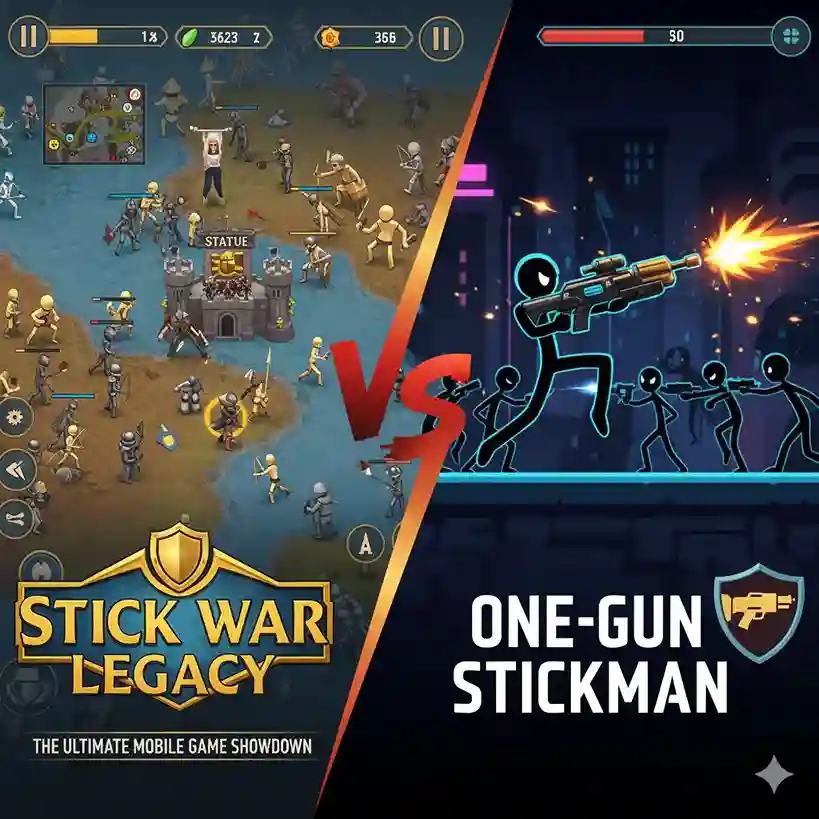
At-a-glance comparison
| Feature | Stick War: Legacy | One Gun: Stickman |
|---|---|---|
| Genre | Real-time strategy / army builder | 2D action/shooter RPG |
| Core loop | Mine gold → recruit units → capture statue → upgrade units | Clear waves → upgrade weapons/skills → boss fights |
| Platforms | Android, iOS, web (original) | Android (mobile) + PC ports (Steam/others) |
| Ease of pick-up | Moderate — learning curve for unit micromanagement | Very easy — immediate action |
| Social / community | Active subreddit & long-term fans | Smaller but stable community, Steam port exists |
| Monetization | IAPs, ads; modded APK ecosystem | IAPs, ads (many users mention ads in reviews) |
| Good for | Strategy players, short-session tactics | Action fans, repeat-wave grinding |
Sources: official Play Store pages and community threads.
Core Features Comparison (What Actually Matters to Players)
1. Gameplay Approach
Stick War: Legacy is fundamentally a real-time strategy experience. You don’t just fight — you manage gold miners, decide when to defend or attack, control formations, and sometimes manually operate individual units. Winning depends on timing, positioning, and unit composition. It rewards patience and tactical thinking.
One Gun: Stickman focuses on reflex-driven combat. You control a single character, move quickly, shoot continuously, and survive increasingly difficult waves. It’s less about planning and more about reaction speed and upgrade optimization.
2. Character Variety
In Stick War: Legacy, you unlock and command multiple unit types — swordwrath, speartons, archidons, magikill, giants — each serving a different battlefield role. Strategy changes depending on which combination you use.
In One Gun: Stickman, you control only one stickman character. Instead of switching characters, you improve weapons, skills, and stats. Customization exists, but it’s vertical progression rather than variety in playstyle.
3. Single-Player Experience
Stick War: Legacy offers multiple modes including Campaign, Tournament Mode, Missions, and special events. Each mode changes objectives and pacing, which increases replay value.
One Gun: Stickman is structured around progressive levels and boss fights. Difficulty scales steadily, but the core objective remains consistent — clear waves, upgrade, repeat.
4. Multiplayer Capability
Stick War: Legacy includes multiplayer elements (depending on version), allowing competitive battles or team-based play, which extends engagement beyond solo gameplay.
One Gun: Stickman is strictly single-player. There is no real-time PvP; competition exists only through leaderboard comparisons.
5. In-Game Purchases & Monetization
Stick War: Legacy (official version) includes optional in-app purchases for skins, upgrades, and convenience features. Mod APK versions claim unlimited resources, but these come with security risks and no official support.
One Gun: Stickman offers free gameplay but locks certain upgrades, benefits, or ad-removal features behind paid options. Progress can feel slower without purchases.
6. Graphics Style
Stick War: Legacy uses a clean 2D stick-figure art style with smooth battle animations and large-scale army clashes. The focus is not realism but clarity — you can instantly understand what’s happening on the battlefield, which is critical in a strategy game.
One Gun: Stickman leans more into arcade-style action visuals. Explosions, boss designs, and weapon effects are more pronounced compared to Stick War. It feels more chaotic and visually intense during combat.
7. Controls & Learning Curve
Stick War: Legacy requires more tactical input. You manage miners, command units, switch formations, and sometimes manually control individual soldiers. There is a learning curve, especially for beginners who are new to strategy games.
One Gun: Stickman is much simpler. Movement, shooting, and skill activation are straightforward. The game is easy to learn within minutes, making it ideal for casual players.
8. Performance on Devices
Stick War: Legacy handles large armies, which can occasionally feel heavy on very low-end devices during intense battles. However, overall optimization is solid.
One Gun: Stickman is generally lighter because you control a single character. It tends to run smoothly even on older smartphones.
| Feature | Stick War: Legacy | One Gun: Stickman |
|---|---|---|
| Gameplay Style | Real-time strategy with army control | Fast-paced action shooter |
| Combat System | Multiple units, formation control, resource management | Single character, reflex-based shooting |
| Character Variety | Multiple unit types with different roles | One character with upgradeable weapons |
| Game Modes | Campaign, Missions, Tournament, Events | Level-based progression with boss fights |
| Multiplayer | Available in certain versions | No real-time multiplayer |
| Difficulty Curve | Strategic learning curve | Skill-based scaling difficulty |
| Monetization | Optional IAPs (mods exist but risky) | IAPs + ads, slower progress without paying |
Gameplay deep-dive (what you actually do)
Stick War: Legacy is essentially a portable micro-RTS. You control miners, build four-to-six unit types (spear, sword, archer, mage, giant variants), and must balance economy and offense. Matches reward decision-making: when to push, what upgrades to buy, and which formations to send. It’s slower, tactical, and very satisfying when a plan comes together. Play Store description and multiple community write-ups outline this structure.
One Gun: Stickman boils the experience down to action loops. You run a stickman, shoot increasingly absurd enemies, level up damage/HP/skills and face huge bosses. It’s more about reflexes, building a single-character kit, and chasing incremental upgrades. Uptodown/Play Store descriptions and screenshots show the RPG-lite upgrade hubs and boss waves.
My hands-on feeling: I find myself reaching for Stick War when I want focused, 10–15 minute sessions where tactics pay off. With One Gun, I’ve killed time on commutes — thirst for progression and boss-mashing makes it addictive in a different, more repetitive way.
Progression, difficulty & replayability
- Stick War: Progression is map and campaign-based. Difficulty spikes when enemies require exact unit counters. Replayability comes from trying different unit builds and speed-running levels. Community mods and guides extend life.
- One Gun: Progression is level-and-upgrade based; you grind waves and collect coins to upgrade. It’s very replayable if you enjoy incremental builds, but can feel grindy after many hours. Community feedback notes heavy ad presence for some users.
Community & trust signals
- Stick War has a long-standing community (active subreddit where players share strategies, bugs and nostalgia). That kind of sustained community is an big win — it signals a stable playerbase and many user-tested strategies.
- One Gun has strong user review counts on Play Store (large install base and many ratings), and a small Steam presence for the sequel/ports — evidence it’s popular among casual action players.
Monetization & mods (be pragmatic)
Both titles use ads and in-app purchases. Stick War’s ecosystem also includes modded APKs and “unlocked” versions floating around — popular with players but risky for security and not something I recommend. One Gun users commonly mention ads and paywalls in reviews; it’s serviceable free-to-play but expect interruptions unless you pay. If you value device security and stable updates, stick to official stores.
Some players revisit Stick War Legacy old versions to compare balance changes and earlier difficulty scaling.
Community discussion (real voices summarized)
I scanned Reddit threads and Play Store reviews to see what players actually say (paraphrased):
- “Stick War still feels like the old Flash game I loved — perfect for short strategy bursts.” — common sentiment on r/StickWarLegacy.
- “One Gun is pure boss-mash fun; very grindy but satisfying when you beat the big beast.” — frequent Play Store comment.
I’ve played both with those points in mind: nostalgia + strategy for Stick War; fast, addictive progression for One Gun. Many long-time fans who started with Legacy eventually moved to Stick War Saga for its multiplayer-focused evolution of the Inamorta universe.
Which Game Is Harder?
Difficulty is subjective — but these two games challenge players in very different ways.
Strategic Difficulty vs Mechanical Difficulty
Stick War: Legacy is harder in terms of decision-making pressure. If you mismanage gold early, build the wrong unit composition, or attack at the wrong time, you can lose quickly. Higher mission levels demand precise timing, defensive awareness, and smart counter-unit selection. The difficulty comes from strategy errors rather than reaction speed. On higher Insane missions, many strategy-focused players switch to Stick War Legacy for PC for improved unit control precision.
One Gun: Stickman is harder in terms of mechanical skill and endurance. Later waves introduce aggressive enemies, heavy projectile spam, and boss fights that require constant movement. Survival depends on reflexes, positioning, and upgrade efficiency.
Difficulty Comparison Table
| Difficulty Factor | Stick War: Legacy | One Gun: Stickman |
|---|---|---|
| Learning Curve | Moderate – requires strategy understanding | Very low – easy to start |
| Skill Type | Tactical thinking | Reflex-based action |
| Early Game | Manageable but punishing if careless | Easy and fast-paced |
| Late Game | Demands optimized strategy | Requires strong upgrades and reaction speed |
| Punishment for Mistakes | High (wrong strategy = defeat) | Medium (can recover with skill or upgrades) |
So, Which Is Harder Overall?
- If you struggle with planning and multitasking, Stick War: Legacy will feel harder.
- If you struggle with reaction time and fast-paced combat, One Gun: Stickman will feel harder.
In simple terms:
Stick War tests your brain. One Gun tests your hands.
This distinction is important because many players search for “which game is harder” when deciding which one matches their skill set.
Who Should Play Which Game?
If you’re still unsure, this quick breakdown will help you decide in seconds.
Choose Stick War: Legacy If You:
- Enjoy strategy games like RTS or tower defense
- Like managing resources and planning attacks
- Prefer controlling multiple units instead of one character
- Want multiple modes (Campaign, Tournament, Missions)
- Enjoy tactical wins that feel earned through smart decisions
Stick War is for players who like thinking ahead and adapting strategies. If you enjoy outsmarting AI rather than outshooting enemies, this is your game.
Choose One Gun: Stickman If You:
- Prefer fast action over strategy
- Like upgrading weapons and watching numbers grow
- Enjoy boss fights and survival-style gameplay
- Want something easy to start and hard to master
- Play in short bursts and don’t want to manage armies
One Gun is for players who enjoy adrenaline and steady progression. If you want instant action without complex planning, this is the better choice. Players who prefer hero-focused combat progression may also find Stickman Legends appealing due to its boss fights and skill-tree mechanics.
Final Decision Shortcut
| Your Preference | Best Pick |
|---|---|
| Strategy & planning | Stick War: Legacy |
| Fast action & reflex combat | One Gun: Stickman |
| Multiple modes & army control | Stick War: Legacy |
| Simple controls & boss fights | One Gun: Stickman |
FAQs
Final Verdict: Strategy vs Action — Pick Your Battlefield
After comparing gameplay depth, character variety, difficulty curve, and long-term engagement, it’s clear that Stick War: Legacy and One Gun: Stickman are not direct competitors — they serve different player mindsets.
Stick War: Legacy is the smarter, more tactical experience. It rewards planning, patience, and adaptation. Mistakes are costly, and victories feel earned. If you enjoy thinking several moves ahead and controlling an entire army rather than a single character, this game delivers more strategic depth and replay variety.
One Gun: Stickman is the faster, more adrenaline-driven option. It focuses on constant action, upgrades, and boss encounters. You don’t need to manage resources or memorize counters — you just move, shoot, survive, and improve. It’s easier to jump into but can become repetitive if you prefer strategic complexity.
From a long-term perspective, Stick War offers more gameplay diversity due to its multiple modes and unit combinations. One Gun offers smoother pick-up-and-play accessibility for casual sessions.
So the real question isn’t “Which game is better?”
It’s “What kind of player are you?”
- If you want strategy and control → choose Stick War: Legacy.
- If you want speed and action → choose One Gun: Stickman.
Both games succeed at what they aim to do. The better choice depends entirely on whether you want to outthink your opponent — or outgun them.

George Harrison
Last Updated: July 2026
George is a long-time strategy gamer with extensive hands-on experience in both large-scale stickman warfare titles and fast-paced solo combat games. His expertise is rooted in deep campaign testing in Stick War: Legacy — particularly Crown of Inamorta on Insane difficulty — as well as practical playthrough analysis of action-based titles like One Gun: Stickman.
Rather than relying on surface-level impressions, George tests mechanics through repeated mission runs, difficulty scaling comparisons, progression pacing, and community-informed strategy validation. His comparisons reflect actual gameplay performance differences — not just feature lists.
Disclaimer:
The modified (MOD) builds referenced in discussions are analyzed strictly for evaluating gameplay mechanics, balance shifts, resource scaling, and progression impact. This analysis is provided for technical comparison purposes only and does not encourage unfair competitive advantage.
Players are strongly encouraged to support official developers by playing through legitimate app store versions. Any experimentation with modified builds should be done responsibly, offline, and at the player’s discretion.