I Tested Every Stick War: Legacy Unit Against Every Other Unit
I have seen plenty of Stick War: Legacy discussions that try to answer one question:
Which unit is the strongest?
After playing the game for years, I think that is the wrong question.
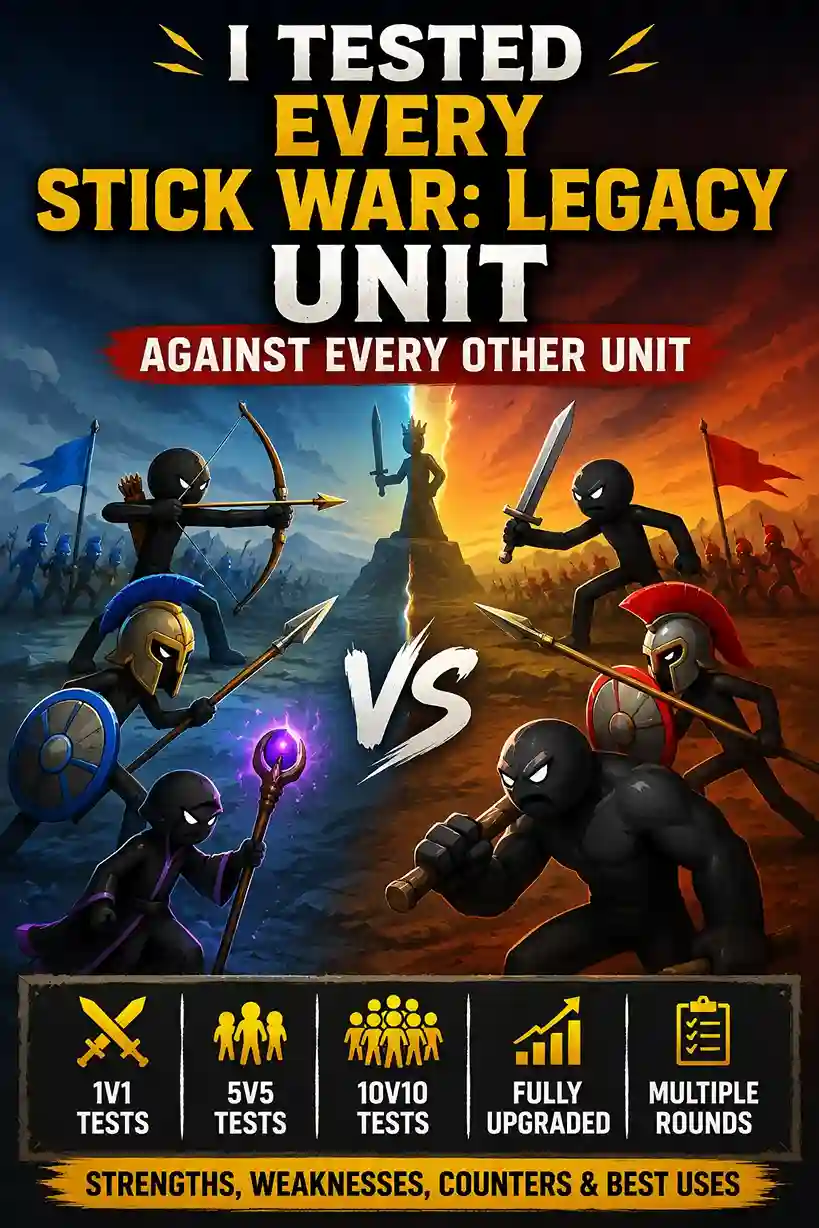
A unit that dominates a one-on-one fight may be a poor choice in a large army. A ranged unit can look weak if an enemy reaches it, but completely change a battle when protected by a frontline. A Magikill may not be judged fairly by a basic duel because its abilities are designed to affect groups. Even a cheap Swordwrath can produce a result that looks surprising when speed, numbers, and direct control enter the equation.
So I decided to test the core Order units against one another instead of relying on simple tier lists or general opinions.
The purpose of this experiment was not to create one universal ranking. I wanted to find out what each unit is actually good at, what counters it, and how much the result changes when the battle goes from 1v1 to a larger fight.
The core combat roster I tested consisted of the Swordwrath, Archidon, Spearton, Magikill, and Giant. I treated the Miner separately because its primary role is gathering gold rather than fighting. For a broader overview of the game’s Stick War: Legacy characters, I have also documented the main characters and their roles separately.
How I Tested the Stick War: Legacy Units
I wanted the tests to be as consistent as possible. A simple fight between two units does not automatically tell you which unit is better. The result can change because of upgrades, spells, positioning, player control, or the number of units involved.
The basic testing rules
For the main unit comparisons, I excluded spells so that I could isolate the combat performance of the units themselves. That is different from normal gameplay, where Stick War: Legacy spells can significantly change the outcome of an engagement. I used the following principles:
- The same battlefield conditions
- The same upgrade level for both sides
- The same number of units in each test
- No spells
- No outside assistance
- Multiple rounds where a result needed confirmation
- Separate consideration for AI-controlled and directly controlled units
I also avoided mixing different questions together. For example, a fully upgraded Magikill should not be compared directly with a basic Swordwrath and then used to create a general ranking. That would tell us almost nothing. The goal was to compare like with like first.
Why I tested more than one unit
A 1v1 test is useful, but it is also limited.
A single Archidon fighting a single Swordwrath answers one question: what happens when these two units meet under those conditions?
It does not answer:
- Which unit is better in a 5v5 fight?
- Which unit scales better in a large army?
- Which unit benefits most from protection?
- Which unit becomes more dangerous when directly controlled?
- Which unit is most useful in an actual mission?
That is why I separated the experiment into individual fights, small groups, and larger battles.
The Units I Tested
Swordwrath: Fast Melee Pressure
The Swordwrath is the basic melee fighter, but “basic” does not mean irrelevant.
Its strengths are:
- Low cost compared with heavier units
- Fast access to the battlefield
- Strong early pressure
- Ability to close distance quickly
- Potential to overwhelm a more expensive unit with numbers
The main question I wanted to answer was whether the Swordwrath’s low cost and speed could compensate for its lower durability.
I was also particularly interested in how the unit performed against heavy targets. A recent community discussion about directly controlled units even highlighted the Swordwrath’s ability to perform surprisingly well against a Giant in certain circumstances. I treated that as a hypothesis to test rather than accepting it as fact.
Archidon: Ranged Damage Versus Survival
The Archidon is one of the clearest examples of why unit matchups cannot be judged by raw damage alone.
Its major advantage is range. Its major problem is what happens when a melee unit reaches it.
The Archidon is generally described as a long-range harassment unit that can deal substantial damage while maintaining distance, but it has less durability than frontline units and needs protection.
So I tested two different questions:
- How does the Archidon perform when it has room to attack?
- What happens when the opponent successfully reaches it?
Those are completely different battles.
Spearton: The Frontline Test
The Spearton was one of the most interesting units to evaluate because it combines durability with offensive tools.
Its defensive abilities, speed, damage, and spear throw give it more options than a simple “tank” label suggests. The Stick War Wiki also identifies the Spearton as a versatile unit that can operate both offensively and defensively.
In my testing, I paid particular attention to:
- How consistently it survived direct melee combat
- How it performed against ranged units
- Whether its ranged spear attack changed a matchup
- How much its defensive tools affected the result
Magikill: The Unit That Cannot Be Judged Properly in a Simple Duel
The Magikill is probably the easiest unit to misunderstand.
It is expensive, relatively slow, and vulnerable if an enemy reaches it. At the same time, its abilities can dramatically change a group battle.
The unit’s Blast and minion abilities are precisely why I did not want to judge it only by a basic attack-versus-basic attack duel. Its value increases when multiple enemy units are close together.
This created an important testing rule:
A unit’s individual combat performance and its battlefield impact are not always the same thing.
Giant: Raw Power Versus Efficiency
The Giant is designed to win battles through size, durability, and heavy damage.
That does not automatically make it the best unit in every situation.
A Giant costs more, takes longer to produce, and can be attacked from range. Therefore, I looked at more than whether it could defeat another unit.
I also considered:
- How many cheaper units could be produced for the same investment
- Whether ranged attacks changed the result
- How effectively it handled groups
- Whether its area damage became more valuable as the number of enemies increased
What the 1v1 Tests Actually Tell Us
The biggest lesson from the individual matchups is that there is no meaningful universal “best unit” without defining the conditions.
A 1v1 test is most useful for identifying direct counters and weaknesses.
For example:
- A ranged unit wants time and distance.
- A melee unit wants contact.
- A heavy unit wants to survive long enough for its durability and damage to matter.
- A spellcaster wants enough time and space to use its abilities.
This means the battlefield often decides the result before the units even begin attacking.
My 1v1 matchup framework
Rather than ranking the units from first to last, I recorded each matchup using four questions:
| Question | Why It Matters |
| Who won? | Basic combat result |
| How consistently? | Separates reliable counters from close results |
| What caused the win? | Identifies the actual advantage |
| What changed the result? | Reveals weaknesses and conditions |
This approach is more useful than simply writing “Spearton beats Swordwrath.”
The better conclusion is:
Spearton is favored when the Swordwrath must fight directly, but the result can change when cost, numbers, positioning, or direct control are introduced.
That distinction matters when building an actual army.
Why the 5v5 Tests Were More Useful Than the 1v1 Tests
The 5v5 battles exposed something that individual fights cannot show: units do not fight in isolation during a real match.
A group of Archidons can focus fire on one target. A group of Swordwrath can surround an enemy. Multiple Speartons can create a much stronger frontline than one Spearton. A Magikill can affect several targets at once.
This is where the concept of “strong against” becomes more complicated.
A unit may be:
- Strong against one target
- Weak against a group
- Strong when protected
- Weak when isolated
- Strong under direct control
- Less effective when left to the AI
The Magikill is the clearest example. Its group impact can be much more important than the result of a simple duel.
The same applies to the Giant. A heavy unit’s ability to damage or disrupt multiple enemies can become more valuable as the number of targets increases.
The 10v10 Battles Changed the Meaning of “Strong”
The larger battles were the most useful for understanding actual army composition.
At this point, the question is no longer:
Can Unit A defeat Unit B?
It becomes:
What happens when several units perform their intended roles at the same time?
A balanced army can produce results that a unit-versus-unit chart cannot predict.
For example:
- Frontline units can protect Archidons.
- Archidons can damage targets before they reach the frontline.
- Magikill abilities can punish clustered enemies.
- Giants can disrupt formations and absorb pressure.
- Swordwrath can provide fast numbers and pressure without requiring the same investment as heavier units.
This is why I would never use a 1v1 ranking alone to decide the best army for a difficult mission.
What I Learned About Directly Controlling Units
Direct control changes the experiment.
The official game description specifically emphasizes that players can control individual units as well as command formations.
That matters because some units benefit more from player input than others.
A player can:
- Move a melee unit around an enemy
- Keep a ranged unit at a safer distance
- Choose a better target
- Time an ability
- Retreat from a bad engagement
- Attack a vulnerable unit instead of the nearest unit
This is why I kept direct-control results separate from ordinary battlefield behavior.
A unit’s AI performance is not always the same as its maximum potential in the hands of an experienced player. Unit matchups are only one part of winning consistently. I also explain the broader principles behind a Stick War: Legacy winning strategy, including timing, resource management, unit selection, and battlefield decisions.
My Practical Unit Counter Table
The most useful result of the testing was not a single overall tier list. It was a practical counter framework.
| Unit | Strongest When | Weakest When | Best General Role |
| Swordwrath | Closing distance and applying pressure | Fighting tougher units without support | Fast melee pressure |
| Archidon | Protected and given room to attack | Caught by fast melee units | Ranged damage |
| Spearton | Holding the frontline or taking direct fights | Facing overwhelming numbers or focused counters | Frontline defense |
| Magikill | Fighting grouped enemies with time to use abilities | Caught alone or attacked before using abilities | Area damage and support |
| Giant | Absorbing pressure and disrupting groups | Focused by ranged damage or surrounded by cheaper units | Heavy frontline |
| Miner | Safely gathering gold | Forced into combat | Economy |
The important point is that the “best use” column is often more useful than a ranking.
A player does not need the strongest unit in every category. The player needs the unit that solves the current problem.
The Biggest Mistake I Would Make With These Results
The biggest mistake would be taking the table above and building an army entirely from the unit that appears strongest.
That usually creates a new weakness.
A large number of expensive units may leave the economy too weak. A ranged-heavy army may collapse if the frontline disappears. A melee-heavy army may struggle to reach protected ranged units. A Magikill can be extremely valuable, but losing one before it can use its abilities is expensive.
The better approach is to ask:
What is the enemy actually doing?
If the enemy is:
- Rushing with melee units, you need a way to stop the initial pressure.
- Using ranged units, you need protection and a method of closing distance.
- Relying on large groups, area damage becomes more valuable.
- Using heavy units, you need enough sustained damage to bring them down.
- Defending behind a strong frontline, simply producing more basic melee units may not solve the problem.
This is the same reason I prefer testing individual matchups rather than publishing a universal tier list.
Common Misconceptions About Stick War: Legacy Units
“The strongest unit always wins”
Not necessarily. Cost, numbers, positioning, upgrades, and control all affect the result.
“A unit that loses a 1v1 is useless”
This is one of the worst conclusions to draw. A support or ranged unit may be much more valuable in an army than in a duel.
“The most expensive unit is automatically the best investment”
Price and combat strength are not the same thing. A cheaper unit may be more useful if it can be produced quickly and used in larger numbers.
“A tier list tells you how to win every mission”
It does not. Missions have different enemies, objectives, starting resources, map layouts, and restrictions. A unit that performs well in a controlled battle may not be the best choice for a specific campaign mission.
Frequently Asked Questions
Which is the strongest unit in Stick War: Legacy?
There is no universal winner. The answer depends on whether you are judging 1v1 combat, group battles, cost efficiency, direct control, defense, or offensive pressure.
Can a Swordwrath defeat a Giant?
The result depends heavily on the testing conditions, including upgrades, direct control, positioning, and whether the Giant can use its full combat potential. A single matchup should not be treated as a universal rule.
Is the Archidon better than the Swordwrath?
Not generally. The Archidon is stronger when it can maintain range, while the Swordwrath is more effective when it reaches melee range quickly.
Is the Spearton the best defensive unit?
The Spearton is designed to perform strongly in frontline situations, but “best” still depends on the enemy composition and the number of units involved. Its defensive tools and durability make it one of the most versatile frontline choices.
Is the Magikill better against groups?
That is where the Magikill’s abilities become especially important. Its value cannot be fairly judged only through a basic one-on-one fight because its area damage and summoned units can influence multiple targets.
Does upgrading change unit rankings?
Yes. Upgrades can change damage, durability, speed, and overall battlefield performance. Base-level and fully upgraded units should be tested separately rather than mixed into one ranking.
What is the best unit for beginners?
A durable and straightforward unit can be easier to use than a unit that requires careful positioning or ability timing. However, beginners should learn unit roles rather than relying on a single unit for every situation.
Are these results valid for every Stick War: Legacy mission?
No. Controlled unit testing shows matchup tendencies, not guaranteed mission outcomes. Mission objectives, enemy compositions, map conditions, resources, and special rules can all change the best strategy.
Map layout and mission context can also affect the best decision, which is why a Stick War: Legacy Saga map guide can be more useful than a universal unit ranking when planning a specific campaign battle.
Final Verdict: There Is No Single Best Stick War: Legacy Unit
After testing the units against each other, I think the most useful conclusion is also the simplest:
There is no single best unit for every situation.
The better question is:
Which unit solves the problem in front of you?
The Swordwrath brings speed and pressure. The Archidon brings range. The Spearton provides a durable frontline. The Magikill can change the shape of a group battle. The Giant brings heavy durability and battlefield disruption. The Miner supports every strategy by keeping the economy running.
That is why my final ranking is not one simple list from number one to number five.
Instead, I would judge the units by category:
- Best for early pressure: Swordwrath
- Best for ranged support: Archidon
- Best for frontline durability: Spearton
- Best for group damage: Magikill
- Best for heavy frontline pressure: Giant
- Most important non-combat unit: Miner
The strongest army is usually not the one containing only one “best” unit. It is the army where each unit is used for the job it is actually suited to perform.
If you are building your own strategy, my advice is simple: stop asking which Stick War: Legacy unit is strongest in general. Start asking what the enemy is weak against, what your economy can support, and which unit can solve that specific problem. These principles also connect with my broader Stick War: Legacy tips for improving gameplay.
Related strategy: For the best results, use this testing framework alongside mission-specific testing. A unit that wins a controlled battle is not automatically the right choice for every campaign challenge.